★★★★★
Diplomatic residence, Grade I listed. Complex security requirements. KR provided cleared personnel, signed NDAs, and completed a full parapet lead relining over three weekends without disrupting ongoing functions. Beyond reproach.

Westminster roofers — Belgravia, Pimlico, Victoria. Grade I & II listed heritage work. Slate, lead, and conservation-area specialists.

Westminster — from the Old English west mynster, "the west monastery", referring to the Benedictine abbey founded in the tenth century on Thorney Island — has been the seat of English government since at least the eleventh century. The residential districts of the modern City of Westminster are comparatively recent developments: the marshy Thorney Island and surrounding Millbank were unsuitable for domestic development until the nineteenth century.
The systematic residential development of what we now call Westminster came in two main phases. The first, in the 1820s to 1850s, produced Belgravia — Thomas Cubitt's masterpiece of stucco-fronted Georgian-derivative terraces, laid out on former Grosvenor Estate land north of Buckingham Palace Road. Belgrave Square (1825), Eaton Square (1827), Chester Square (1840) and the surrounding streets are among the most architecturally uniform and prestigious residential districts in Europe.
The second phase, in the 1850s to 1870s, produced Pimlico — Cubitt's younger, slightly more modest stucco terraces filling the area south and west of Belgravia. Both estates have been carefully maintained by the Grosvenor Estate (which still owns and manages the freehold of most of Belgravia) and, in Pimlico, by various institutional and private freeholders. Most of Westminster's SW1 residential stock is Grade II or Grade II* listed. Our work here is almost entirely heritage, usually on stucco-fronted townhouses with pitched slate roofs concealed behind parapet walls, or on the Edwardian mansion blocks that infilled gaps in the later nineteenth century.
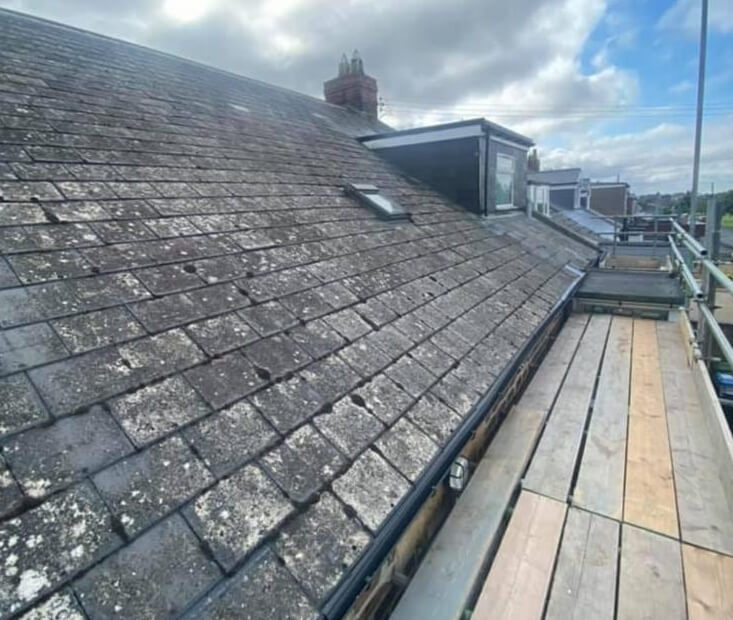
Westminster SW1 residential stock is dominated by stucco-fronted townhouses of the 1820s–1870s — four to six storeys, brick construction with stucco render, pitched Welsh slate roofs behind parapet walls, lead-lined box gutters, and substantial original chimney stacks. These are concentrated in Belgravia (Eaton Square, Chester Square, Belgrave Square and adjoining streets) and Pimlico (Eccleston Square, Warwick Square, St George's Square). Edwardian mansion blocks (Buckingham Gate, Victoria Street area) add a second distinct character. Mews cottages throughout the area — typically two-storey, brick, with low-pitched clay tile or slate roofs.

A general roofer from outside Westminster can, in theory, do the work. In practice, roofing decisions in Westminster are constantly shaped by local factors that an outsider doesn't know: which streets are in conservation areas, which properties are listed, which managing agents handle which blocks, which local scaffolders will or won't take on narrow-street jobs, which conservation officer handles which zone of the borough, which materials merchants actually stock what they claim to.
We've been working in this patch for thirty years. That institutional knowledge — dozens of small pieces of information that we don't even think about any more — is what lets us quote realistic timescales, realistic prices, and deliver to those estimates. It's also why our warranty-work rate is so low: when you know a street, you know what the roof is likely to be hiding before you get up there.
Practically, that means fewer surprises, quicker turnarounds, and more straightforward conservation approvals. Every Westminster client gets the same attention regardless of job size.
We serve every street in the SW1 postcode area. Emergency callouts typically arrive within 60–90 minutes.
A small sample of feedback from recent jobs in the area.
Diplomatic residence, Grade I listed. Complex security requirements. KR provided cleared personnel, signed NDAs, and completed a full parapet lead relining over three weekends without disrupting ongoing functions. Beyond reproach.
Grade II* stucco townhouse, full slate re-roof with listed-building consent. The project was delivered to the highest heritage standard with complete transparency on costs and timings throughout. Conservation officer inspection was flawless.
Pimlico stucco terrace in a Trust's property. Roof and parapet work completed under ongoing maintenance contract. Consistent quality across multiple properties over several years. Our default heritage contractor for the area.
Complete mews-cottage re-roof including change from concrete tile (1960s inappropriate replacement) back to handmade clay plain tile with conservation officer blessing. Listed-building consent handled by KR, sourced tiles from Kent, delivered an immaculate finish.
1. The phone call or email. You ring us on 0330 223 7665 or drop a line to info@kensingtonroofers.co.uk. We'll ask a handful of diagnostic questions — property type, roof age if known, specific issues, whether you've had other quotes — and book a site visit.
2. The site visit. A senior tradesman attends at a time that suits you, typically within 3–5 working days. We'll go up on the roof if safe (often via a loft hatch and ladder, sometimes needing a tower), photograph everything, and discuss options with you on the spot.
3. The written quote. You'll receive a detailed written quote within a further 3–5 working days. It itemises materials by brand and spec, scaffold by duration, labour by day rate and crew size, and waste removal by skip. You can compare it line-by-line against other quotes.
4. Acceptance and scheduling. If you accept, we agree a start date. For smaller repairs, typically 1–2 weeks out; for re-roofs, 3–6 weeks depending on scaffold and material lead times. Deposit schedules are clear and capped.
5. The work. Scaffold goes up on day one, strip and work proceeds through the following days, and scaffold comes down on the last day. You get a daily update from the site foreman; end-of-day tidying and overnight weather protection are standard.
6. Handover. Final walk-around with you, guarantee certificate, manufacturer warranties, photographic record of the finished work, and waste transfer notes. Final invoice issued after your sign-off.

Questions specific to working in Westminster. For general questions see our main FAQ page.
Our core tradesmen hold up-to-date DBS checks and can be cleared for specific diplomatic-residence work where required by embassy security officers. We've worked on multiple diplomatic properties in Belgravia under NDAs and with bespoke security arrangements.
Westminster City Council's conservation process is rigorous — for Grade I and II* listed properties the process can take 10–12 weeks and requires detailed heritage statements, drawings, and materials samples. For standard Grade II listed properties it's closer to 8 weeks. We handle full applications on behalf of clients and have a good track record of first-time approvals.
Yes. As in Mayfair, a substantial proportion of Belgravia's freehold is still held by the Grosvenor Estate, with managing agents handling day-to-day property management. We're an approved contractor for a number of these properties and are familiar with the Estate's heritage specification standards.
Residential properties in the Cubitt-built Belgravia and Pimlico grids don't typically interface with parliamentary security. However, properties closer to the Houses of Parliament or along Victoria Street may require coordination with Westminster Council's security team for scaffold permits. We handle this routinely.
Architecturally yes — both are Thomas Cubitt's stucco terrace developments from similar periods, built to similar detailing. Pimlico's roofs, parapets and boxes are essentially scaled-down Belgravia. Heritage specification standards are similar. The main difference is that Pimlico is less tightly managed by a single freeholder and has more individual owner-freeholders.
We cover all of SW1 with free site visits, written quotes and 24/7 emergency callouts.
0330 223 7665