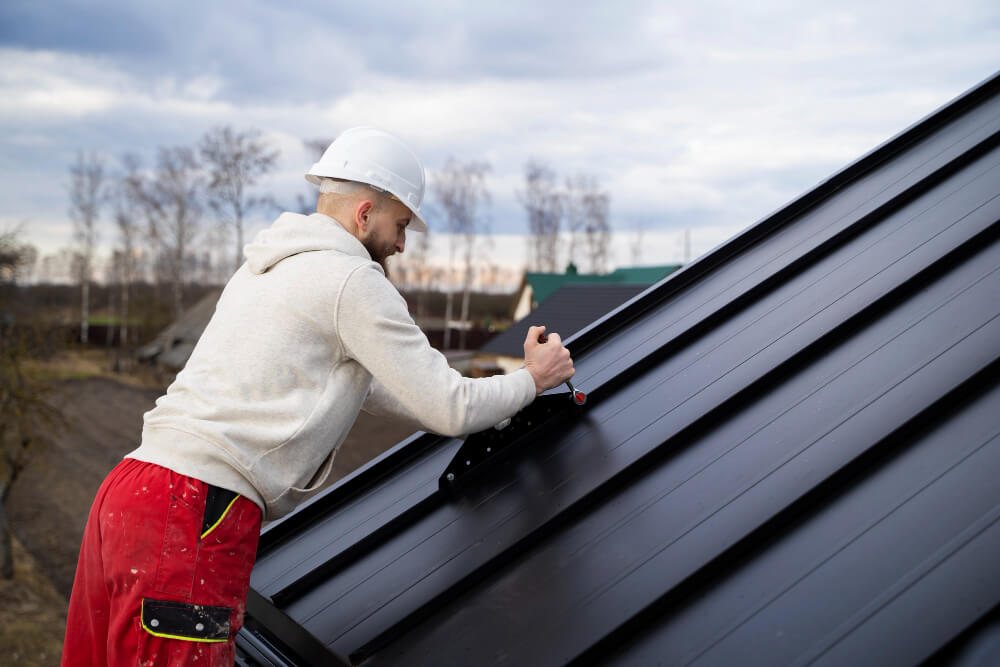
Full slate re-roof on our three-storey terrace. Conservation-area compliant spec, reclaimed Welsh slate to match the neighbours, all done in six working days including scaffold. The crew were extraordinarily polite — my kids still talk about them.
Hammersmith roofing specialists — Brook Green, Ravenscourt Park, Hammersmith Grove terraces. Slate, lead, flat roofs. Free quotes, 10-year guarantee.
Hammersmith — from the Old English hamor smiþ, "hammer smith", suggesting an early blacksmithing settlement — was a small hamlet on the Great West Road for most of its history, occupied by craftsmen supplying the Thames traffic and the westbound coaches. It remained predominantly rural until the early nineteenth century. The 1801 census recorded 5,600 inhabitants; by 1901 that had risen to 112,000. That tenfold-plus growth in a century is the story of Hammersmith's housing stock.
The first major building phase was the 1820s to 1840s, producing the stucco and brick villas around Brook Green — some of which survive as individual houses, others converted into flats. The 1860s to 1890s saw the wholesale development of the terraces that now fill most of the area: Ravenscourt Park, Hammersmith Grove, Goldhawk Road, Shepherds Bush Road and the surrounding grid. Edwardian infill filled remaining gaps. Twentieth-century additions include the large 1930s council blocks north of the Uxbridge Road and the extensive post-war rebuild along the river near Hammersmith Bridge.
Architecturally, Hammersmith is transitional — it's not quite as grand as Kensington, not quite as artisan as Fulham. The housing stock is solidly Victorian middle-class terrace, often with decorative brickwork, pitched slate roofs, and individual character details like bargeboards or tiled dormers. The area has several designated conservation areas covering the main historic clusters, but it's less comprehensively protected than RBKC — giving rooftops a little more flexibility in terms of specification.
Hammersmith's housing is dominated by late-Victorian and Edwardian terraces, typically three storeys with pitched Welsh slate roofs and individual chimney stacks. Brook Green has earlier, larger villas with more elaborate roofs. The Ravenscourt Park conservation area contains particularly attractive 1860s–1880s terraces with decorative ridge tiles, finials and brick chimneys. Along the river (Hammersmith Terrace, Chiswick Mall) survive rare Georgian and early-Victorian brick townhouses with pitched clay-tile or slate roofs. Modern infill includes 1960s/70s council blocks (flat roofs, concrete decks) and 1990s–2000s private developments (mixed flat and pitched, various materials).
A general roofer from outside Hammersmith can, in theory, do the work. In practice, roofing decisions in Hammersmith are constantly shaped by local factors that an outsider doesn't know: which streets are in conservation areas, which properties are listed, which managing agents handle which blocks, which local scaffolders will or won't take on narrow-street jobs, which conservation officer handles which zone of the borough, which materials merchants actually stock what they claim to.
We've been working in this patch for thirty years. That institutional knowledge — dozens of small pieces of information that we don't even think about any more — is what lets us quote realistic timescales, realistic prices, and deliver to those estimates. It's also why our warranty-work rate is so low: when you know a street, you know what the roof is likely to be hiding before you get up there.
Practically, that means fewer surprises, quicker turnarounds, and more straightforward conservation approvals. Every Hammersmith client gets the same attention regardless of job size.
We serve every street in the W6 postcode area. Emergency callouts typically arrive within 60–90 minutes.
A small sample of feedback from recent jobs in the area.
Full slate re-roof on our three-storey terrace. Conservation-area compliant spec, reclaimed Welsh slate to match the neighbours, all done in six working days including scaffold. The crew were extraordinarily polite — my kids still talk about them.
Grade II listed 1830s villa with a complex pitched and flat roof combination. KR did the listed-building consent, the conservation-officer liaison, the sourcing of reclaimed materials, and the actual work. Impeccable.
Rear flat roof replacement — previous firm had fitted torch-on felt badly (seams lifting within a year). KR tore it out and replaced in EPDM, with new firring falls and proper upstands. Clean job, fair price, and bone dry ever since.
Rare riverside Georgian house with original clay plain tiles. Three tiles had slipped after a storm. Sourced hand-made replacements to match the 200-year-old tiles and fitted them without disturbing the surrounding work. Skilled.
1. The phone call or email. You ring us on 0330 223 7665 or drop a line to info@kensingtonroofers.co.uk. We'll ask a handful of diagnostic questions — property type, roof age if known, specific issues, whether you've had other quotes — and book a site visit.
2. The site visit. A senior tradesman attends at a time that suits you, typically within 3–5 working days. We'll go up on the roof if safe (often via a loft hatch and ladder, sometimes needing a tower), photograph everything, and discuss options with you on the spot.
3. The written quote. You'll receive a detailed written quote within a further 3–5 working days. It itemises materials by brand and spec, scaffold by duration, labour by day rate and crew size, and waste removal by skip. You can compare it line-by-line against other quotes.
4. Acceptance and scheduling. If you accept, we agree a start date. For smaller repairs, typically 1–2 weeks out; for re-roofs, 3–6 weeks depending on scaffold and material lead times. Deposit schedules are clear and capped.
5. The work. Scaffold goes up on day one, strip and work proceeds through the following days, and scaffold comes down on the last day. You get a daily update from the site foreman; end-of-day tidying and overnight weather protection are standard.
6. Handover. Final walk-around with you, guarantee certificate, manufacturer warranties, photographic record of the finished work, and waste transfer notes. Final invoice issued after your sign-off.
Questions specific to working in Hammersmith. For general questions see our main FAQ page.
We're listed on a number of Hammersmith and Fulham Council approved contractor frameworks for domestic and small commercial roofing work. We've also done work for the council-owned housing stock under separate arrangements. Council work requires specific insurance and H&S documentation that we carry as standard.
Yes. The ongoing Hammersmith Bridge restrictions affect traffic flow on surrounding streets but don't prevent roofing work in the area. We plan deliveries around the revised routes and have factored in the additional time for the ongoing bridge situation.
Yes. These are among the oldest and most valuable houses in Hammersmith, mostly Grade II or II* listed. Work requires listed-building consent, hand-made plain tiles or reclaimed slate, hand-cast lead, and extreme care with original fabric. We have specialists on the team for exactly this work.
W14 straddles Hammersmith & Fulham and Kensington & Chelsea boroughs. We cover it all — mainly Victorian terrace work similar to central Fulham and Hammersmith Grove. If you're unsure which borough your property sits in (and it does matter for conservation status), we'll check as part of the quote.
We cover all of W6 with free site visits, written quotes and 24/7 emergency callouts.
0330 223 7665