★★★★★
River-facing Grade II property with significant exposure to wind-driven rain. The leadwork detailing KR designed for the parapet-to-bay junction has kept us dry through four storms in a row. Genuinely skilled tradesmen.

Royal Borough of Kensington and Chelsea roofing specialists. Covering all RBKC postcodes — listed work, mansion blocks, heritage slate & lead.

The Royal Borough of Kensington and Chelsea was formed in 1965 by the merger of the former Metropolitan Borough of Kensington (which had been granted royal status in 1901 by Edward VII, in honour of Queen Victoria's birth at Kensington Palace in 1819) and the Metropolitan Borough of Chelsea. The combined borough is the smallest in Greater London by area — just 12.13 square kilometres — but contains a density and quality of historic housing stock unmatched anywhere else in the capital.
Geographically, RBKC runs from Kensal Town in the north to the Thames at Chelsea in the south, and from Earls Court in the west to Knightsbridge in the east. Within those boundaries sit fifteen designated conservation areas, covering roughly 70% of the borough's area. Listed buildings number in the thousands. The housing stock is overwhelmingly pre-1919, with a significant minority of inter-war mansion blocks and a smaller proportion of post-war rebuild (particularly around North Kensington).
For a roofing contractor, working across RBKC means working across almost every significant domestic building type of the long nineteenth century — stucco terraces, red-brick mansion blocks, artisans' terraces, mews cottages, villas, workhouse rebuilds, institutional buildings and the occasional exceptional survivor from earlier periods. We cover all of it.
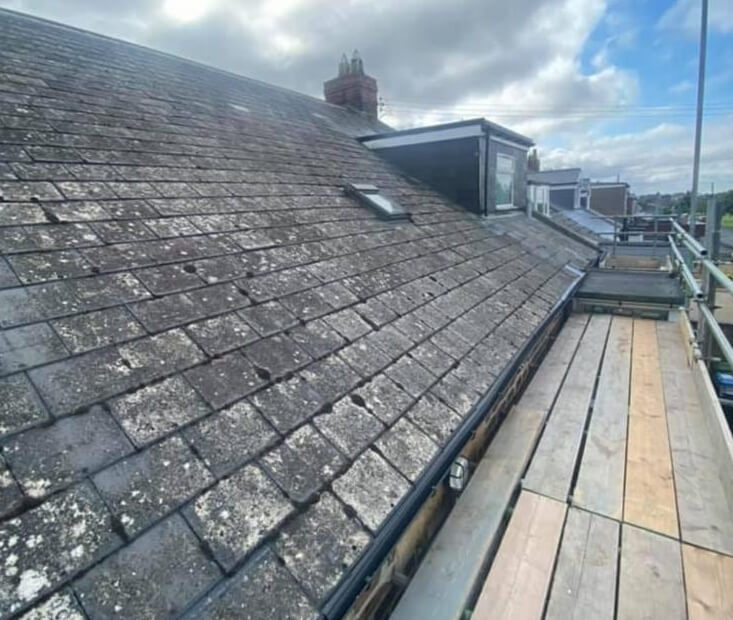
The RBKC housing spectrum is vast. The Thames-facing stucco of Cheyne Walk and Tite Street in Chelsea contrasts with the rough-cast red brick of Golborne and Kensal Town. The mansion blocks of Cromwell Road, Hornton Street and Earls Court Square represent different decades of Victorian and Edwardian purpose-built flats. Mews cottages throughout — from Queen's Gate Mews in SW7 to Hansard Mews in W8 — have their own character. Twentieth-century additions include 1930s flats (Queensway Court, Chelsea Cloisters) and post-war rebuild (the Trellick Tower area, parts of Worlds End Estate). We work on every type.

A general roofer from outside Kensington & Chelsea can, in theory, do the work. In practice, roofing decisions in Kensington & Chelsea are constantly shaped by local factors that an outsider doesn't know: which streets are in conservation areas, which properties are listed, which managing agents handle which blocks, which local scaffolders will or won't take on narrow-street jobs, which conservation officer handles which zone of the borough, which materials merchants actually stock what they claim to.
We've been working in this patch for thirty years. That institutional knowledge — dozens of small pieces of information that we don't even think about any more — is what lets us quote realistic timescales, realistic prices, and deliver to those estimates. It's also why our warranty-work rate is so low: when you know a street, you know what the roof is likely to be hiding before you get up there.
Practically, that means fewer surprises, quicker turnarounds, and more straightforward conservation approvals. Every Kensington & Chelsea client gets the same attention regardless of job size.
We serve every street in the RBKC postcode area. Emergency callouts typically arrive within 60–90 minutes.
A small sample of feedback from recent jobs in the area.
River-facing Grade II property with significant exposure to wind-driven rain. The leadwork detailing KR designed for the parapet-to-bay junction has kept us dry through four storms in a row. Genuinely skilled tradesmen.
Our Victorian mansion block required a full roof replacement across 22 flats. KR ran the whole project with the managing agent — specifications, Section 20 consultation, scheduling — and the job finished to budget and on time. I've recommended them to three other blocks in the square since.
Conservation-area terrace with a leaking valley. They investigated properly, found rotten rafter tops we didn't know about, and did the repairs in a way that'll outlast us. Fair price, clear communication, excellent workmanship.
Listed former studio of James McNeill Whistler. The roof needed the lightest possible touch — reclaimed slate matched to existing, hand-cast lead, lime mortar for the ridge. KR treated the whole project with the respect it deserved.
1. The phone call or email. You ring us on 0330 223 7665 or drop a line to info@kensingtonroofers.co.uk. We'll ask a handful of diagnostic questions — property type, roof age if known, specific issues, whether you've had other quotes — and book a site visit.
2. The site visit. A senior tradesman attends at a time that suits you, typically within 3–5 working days. We'll go up on the roof if safe (often via a loft hatch and ladder, sometimes needing a tower), photograph everything, and discuss options with you on the spot.
3. The written quote. You'll receive a detailed written quote within a further 3–5 working days. It itemises materials by brand and spec, scaffold by duration, labour by day rate and crew size, and waste removal by skip. You can compare it line-by-line against other quotes.
4. Acceptance and scheduling. If you accept, we agree a start date. For smaller repairs, typically 1–2 weeks out; for re-roofs, 3–6 weeks depending on scaffold and material lead times. Deposit schedules are clear and capped.
5. The work. Scaffold goes up on day one, strip and work proceeds through the following days, and scaffold comes down on the last day. You get a daily update from the site foreman; end-of-day tidying and overnight weather protection are standard.
6. Handover. Final walk-around with you, guarantee certificate, manufacturer warranties, photographic record of the finished work, and waste transfer notes. Final invoice issued after your sign-off.

Questions specific to working in Kensington & Chelsea. For general questions see our main FAQ page.
Conservation area designation protects the character of a whole neighbourhood — you need planning permission for certain changes that would usually be permitted development (e.g. dormer additions, satellite dishes, some material changes). Listed status protects the specific building — you need listed-building consent for almost any change to fabric. Many RBKC properties are both listed AND in a conservation area. We help clients understand which applies to their job.
We're on the approved contractor list of several major West London managing agents including Savills, Knight Frank, Ringley, Pennycuick Collins and Pembertons. We're not on a fixed RBKC contract but have a long working relationship with the council's conservation and building-control teams.
RBKC's street-works licensing is centralised — the same form, same lead time (typically 10 working days), same inspector visits for any scaffold touching the highway or parking bays. We handle all of it on behalf of clients. Permit fees are passed through at cost.
Yes. We regularly work with LV=, Aviva, Direct Line, Hiscox and a number of high-end insurers (particularly AXA Art, Chubb and Cadogan Tate) who handle high-value heritage properties. We provide written reports with photographs, can liaise directly with loss adjusters, and accept payment direct from insurers where the policy allows.
Yes. Our emergency callouts aim for 60–90 minutes anywhere within RBKC under normal traffic conditions. The furthest points (Kensal Town in the north, World's End in the south) might add 20 minutes at peak times, but we'll always give you an honest ETA when you ring.
We cover all of RBKC with free site visits, written quotes and 24/7 emergency callouts.
0330 223 7665